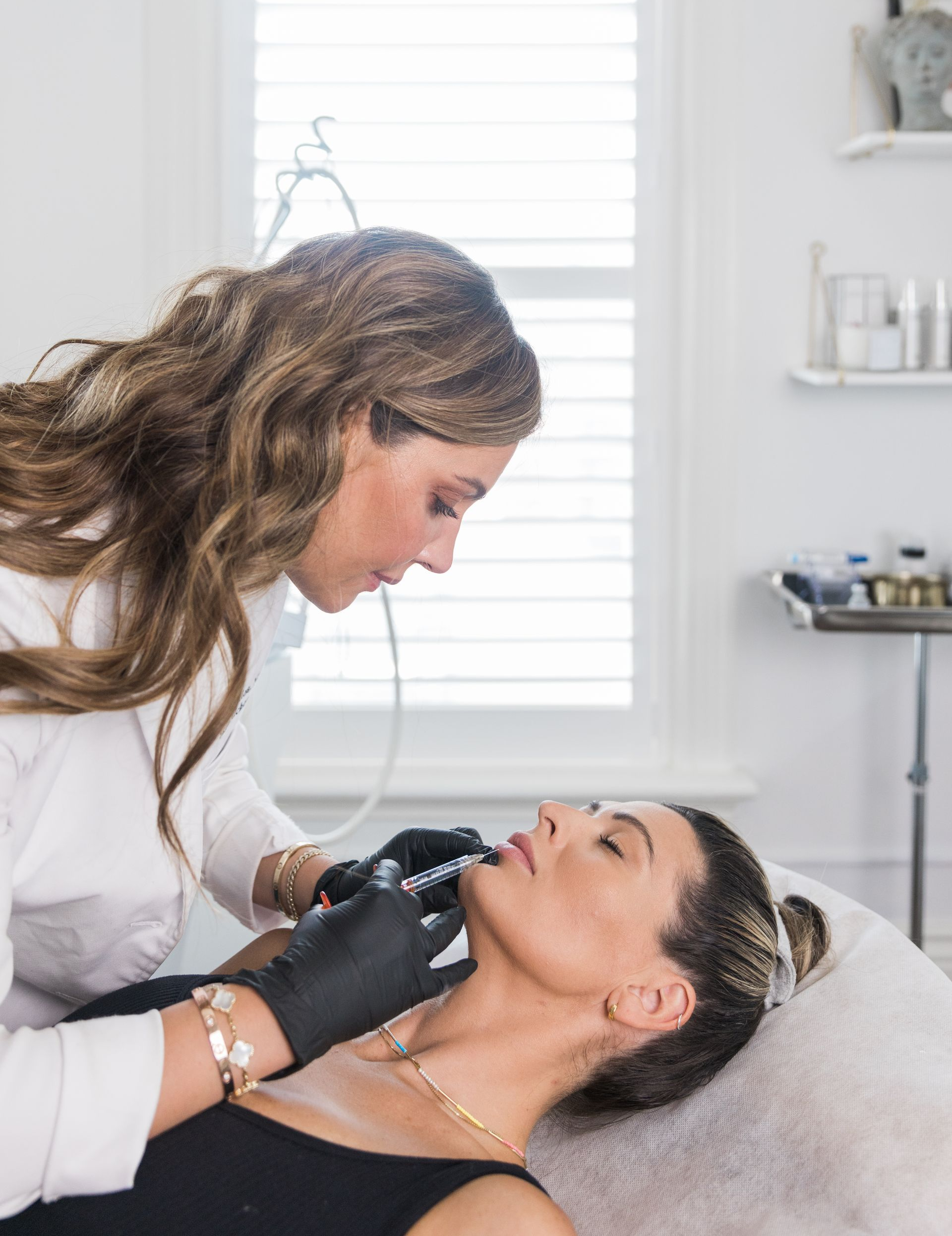
What Happens Before I Touch Your Face
#what to expect at a Botox consultation in London, Ontario
A patient I’d never met sat down across from me at my clinic in London, Ontario last winter and told me she’d been to four different injectors in three years. Each appointment had taken less than thirty minutes. Most of that time was spent on consent forms and product selection. She had spent more time choosing the colour of her car than she’d spent being assessed by anyone making decisions about her face.
She wasn’t unusual. She was the median.
The most common assumption patients bring into a consultation is that the assessment is the part where I look at the lines I’m being asked to treat. It isn’t. The lines are usually the last thing I look at. By the time I get to them, I’ve already decided most of what I’m going to recommend, and a fair amount of what I’m going to recommend against.
This is what’s actually happening in those first thirty minutes, before I touch your face.
Facial Anatomy: I’m reading the architecture, not the surface
Faces don’t change uniformly as they age. They change the way buildings settle — at the load-bearing points first.
The fat pads of the midface migrate downward. The deep medial cheek hollows. Bone resorbs at the orbital rim, the maxilla, the mandible. Ligaments that anchor soft tissue to the underlying bone slacken. Muscles that have spent decades contracting in the same patterns shorten and thicken. The skin envelope, which was once tightly fit to the structure underneath, now drapes over a frame that has changed shape.
The lines you see in the mirror are the most surface-level expression of all of this. They are the last symptom, not the first cause.
When I sit down with a new patient, I’m not looking at the line between her brows. I’m looking at her brow position at rest. The relative volume in her temples. The shape of her cheekbone where it transitions to the lateral midface. The way her jawline meets her ear. The tension in her masseter. Whether her chin projects forward or recedes. Whether one side of her face has descended faster than the other — and they almost always have.
This isn’t extra. It’s the actual work. Treating the line without understanding what’s happening structurally is treating the symptom of a system you haven’t examined.
I’m watching your face when you don’t think I am.
The most useful clinical information often happens before the formal assessment begins.
When a patient walks into the consultation room and sits down, I’m watching how her face moves through ordinary activity. Talking. Smiling at something I said. Frowning when she’s thinking about a question I’ve asked her. Squinting because the light caught her wrong.
These are the muscle patterns I’ll need to plan around — not the deliberate expressions she’ll show me when I ask. People perform when they know they’re being watched. The way a face moves under observation is rarely the way it moves at rest.
I’m watching for asymmetry that the patient doesn’t see. The brow that lifts higher on the right. The side of the smile that pulls more. The lower lip that compensates when the upper face is held still. The jaw that clenches under attention.
Most asymmetry is invisible to the patient because she doesn’t watch herself talk. She watches herself in the mirror, where she’s usually still, and she’s looking at the things that bother her — which are the things she’s already decided are the problem.
My job is partly to confirm her concerns and partly to identify the ones she hasn’t named.
Skin Quality: I’m reading skin behaviour, not skin condition
Skin “condition” is a snapshot. Skin behaviour is a pattern.
When I look at skin, I’m not asking how it looks today. I’m asking how it’s been responding — to weather, to products, to inflammation, to time. I’m reading whether the barrier is intact. Whether there’s underlying redness or vascular reactivity. Whether the texture is the result of buildup, dehydration, sun damage, hormonal pattern, or something more clinical that needs to be addressed before any aesthetic treatment will hold.
This is the part most patients don’t expect to spend time on. They came in for an injectable consult, and instead I’m asking about how their skin reacts when they fly. Whether they get reactive in the cold. Whether their cleanser stings. Whether they’ve had eczema or rosacea, and how it presents.
I’m asking because every aesthetic treatment performs better on skin that is functioning well. A laser performs better on a competent barrier. Filler integrates better in tissue that is hydrated and resilient. Neuromodulator looks better when the skin draped over the muscle is supple and even-toned.
Treating an aesthetic concern in skin that is barrier-compromised, inflamed, or reactive is like installing premium hardwood floors over a foundation that’s still moving. It will look fine for a few weeks. Then it won’t.
I’m reading history, not just history-of-treatment
The medical intake form asks the standard questions. Allergies, medications, previous procedures, complications. I read them.
But I also ask about things that don’t appear on intake forms.
When did your face start looking different to you in photographs?
What’s been happening in your life over the last two years that you’d describe as physically demanding — illness, weight change, sleep disruption, sustained stress?
What does your hormonal pattern look like — perimenopausal, postmenopausal, recently postpartum, on or off contraception?
Are you in active recovery from anything — disordered eating, an autoimmune flare, a major medical event?
These aren’t conversational. They are clinical. The face is a downstream organ. It expresses what the rest of the body is doing. A patient whose collagen has dropped because her estrogen has dropped is not the same patient as one whose skin has changed from sun exposure. They look superficially similar in the mirror. They require different plans.
A clinician who skips this part is treating the face as a closed system. It isn’t.
I’m asking what you actually want — and listening for what you don’t
Most patients arrive with a request. Smooth this line. Lift this area. Even out this side.
The request is the starting point. It is rarely the whole picture.
When I ask a patient what bothers her, I’m listening for two things at once. What she’s saying — and what’s underneath what she’s saying. The most common gap is between a stated concern and the actual goal.
A patient who says she wants her nasolabial folds filled often actually wants her face to look less tired. The fold isn’t the problem. The flattened cheek above it is. Treating the fold directly will make her face look heavier, not lighter — exactly the opposite of what she came in for.
A patient who says she wants more lip volume sometimes actually wants the corners of her mouth lifted, because what she’s seeing in photographs reads as sad. Adding volume to a downturned mouth makes the downturn more pronounced.
A patient who says she wants Botox in her forehead sometimes is reacting to a heavy upper lid that her forehead is compensating for. Treating the forehead first will make the lid heaviness worse.
The translation between what a patient says and what she actually wants happens in the consultation. It can’t happen on a treatment menu.
What this means for what you’re paying for:
Patients sometimes ask me why a complimentary consultation at our clinic is thirty minutes and a competitor’s is fifteen.
The answer is what I just described. Fifteen minutes is enough time to look at lines, recommend a product, and book the next appointment. It is not enough time to assess.
This is also why I don’t quote pricing before the assessment is done. The cost of a treatment is the cost of what the patient actually needs. A patient who came in expecting one syringe of filler and actually needs neuromodulator and skin therapy first should not be sold one syringe of filler. A patient who came in expecting a comprehensive plan and actually needs nothing for another year should not be sold a comprehensive plan.
The assessment is the product. The treatment is the conclusion of the assessment.
When patients are surprised that the consultation took as long as it did, it tells me they’ve never been assessed before. They’ve been triaged into a service. Those are not the same thing.
What to ask before your next consultation
Two questions. Both are reasonable to ask. Both will tell you a lot about what kind of clinic you’re walking into.
How long is the consultation, and what happens during it?
If the answer is fifteen minutes and a treatment plan, you’re being triaged. If the answer is thirty minutes or longer and includes assessment of skin, structure, and movement, you’re being evaluated.
What happens if you determine I don’t need what I came in for?
The right answer is some version of: we’ll explain why, recommend something else if appropriate, and not pressure you to book the original treatment. The wrong answer is some version of: we’ll do what you came in for.
The difference between those two answers is the difference between being a patient and being a customer.
Sonia Vilos is a Nurse Practitioner and the founder of bespøke by SkinAlchemy, a medical aesthetics clinic in London, Ontario. She trained in facial anatomy and injection technique under Dr. Sebastian Cotofana, Dr. Arthur Swift, Dr. Thuy Doan, and Julie Horne across programs in four countries. She is the supervising Medical Director to independent nurse injectors across Ontario. Booking a consultation in London, Ontario