What AI Can’t See
what ai can't see
A patient came in recently and showed me something I hadn’t seen in a long time.
Before her rhinoplasty, her surgeon – based in Toronto, Ontario hadn’t shown her a computer rendering or a digital simulation. He had drawn her result by hand. Pencil on paper. His trained eye translated into a sketch that represented his specific read of her anatomy, her proportions, and what was structurally achievable for her face.
She kept it. She brought it in because she wanted me to understand the standard she was holding her care to.
That drawing was a clinical promise made by someone qualified to make it. It could only exist because a surgeon examined her in person, assessed her specific structure, and committed his judgment to the page. No software was involved. No averaging across thousands of other faces. Just one clinician’s trained assessment of one patient’s anatomy.
That’s the standard. And it’s worth understanding why what’s spreading through medical aesthetics right now is something different.
What AI previews actually are
Before I go further, a distinction matters.
There are clinical 3D imaging tools – Crisalix, TouchMD, and others – that attempt to model treatment outcomes from standardized photographs of your actual face. These are clinical instruments used in clinical contexts. They have limitations, but their intent is to work from your individual anatomy.
What I’m talking about is something else: generative AI tools increasingly used as patient-facing previews of aesthetic outcomes, presented in consultations as a representation of what your result will look like. These tools are trained on datasets – thousands of faces, averaged and idealized – and when they generate a preview of your treated face, they are not modeling your anatomy. They are asking what a treated version of a face like yours tends to look like, statistically, and rendering an answer based on patterns they have seen before.
That answer has no access to your bone structure. No model of your tissue depth, your fat compartment distribution, your retaining ligament position, or your skin thickness. No understanding of how a specific product will interact with your specific tissue architecture.
It shows you a face. That face is a composite. It is not a prediction.
Why your anatomy is the only relevant variable
I have trained extensively in facial anatomy – cadaveric dissection and hands-on work with researchers who are actively mapping how tissue compartments respond to volumization. The consistent finding across that work: anatomy varies dramatically between individuals.
What produces a natural, structurally appropriate result in one patient can migrate, overfill, or create visible irregularity in another – depending entirely on their specific architecture. The position of the pyriform aperture. The thickness of the dermis over the malar eminence. The depth and integrity of the superficial muscular aponeurotic system. These are not minor variations. They determine everything about how treatment behaves.
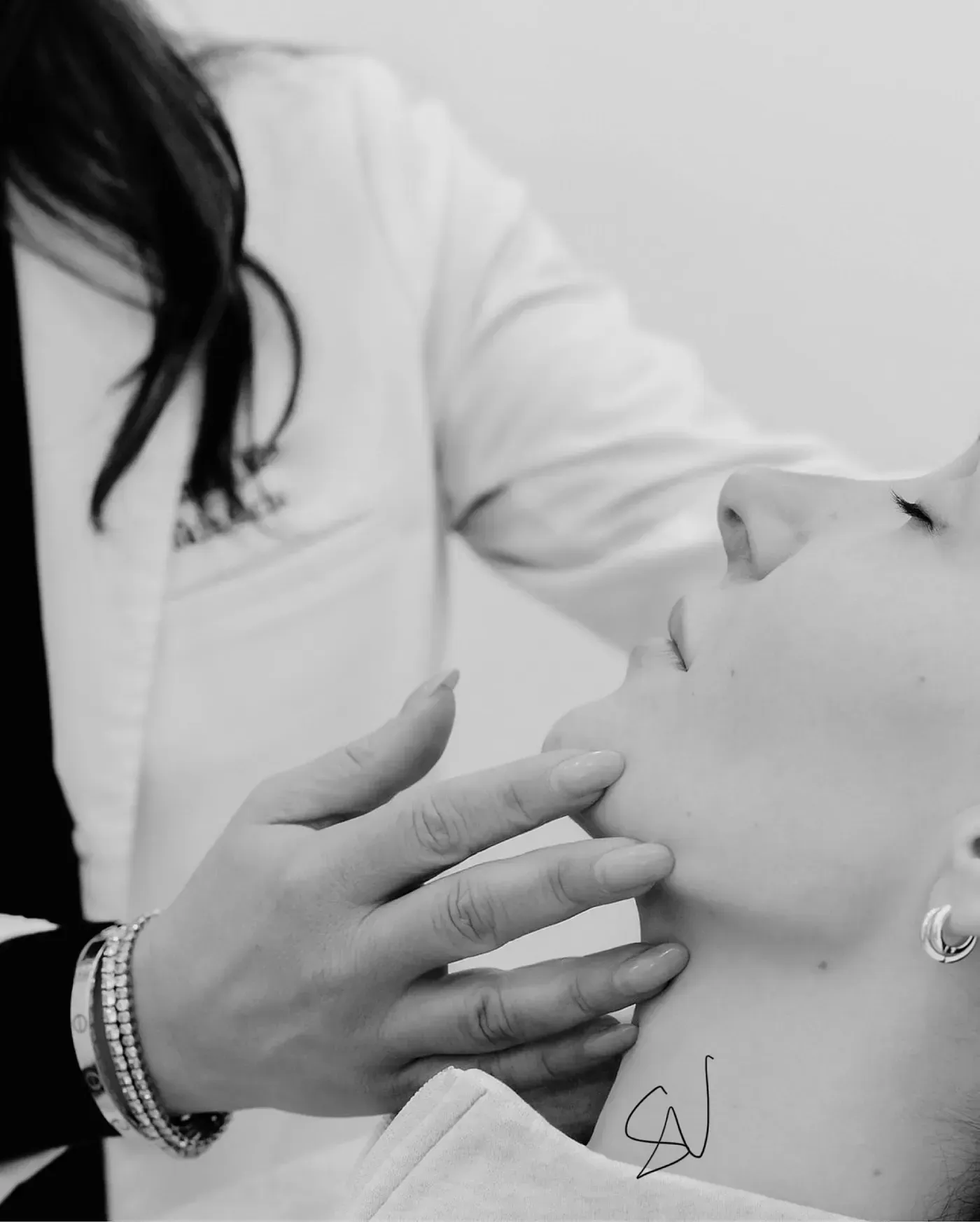
When I plan a treatment, I am working from your face – your specific structure, examined in person, assessed before a single decision is made. The depth of placement, the product selection, the volume, the injection point – all of it is determined by what I find when I look at you. Not by what a treated face tends to look like in a training dataset.
The expectation problem
Published research on AI in aesthetic medicine has flagged this directly: overreliance on AI risks diminishing the human-centered approach essential in procedures where patient expectations and subjective perception of beauty are central to the outcome. That is not a fringe concern. It is the field’s own assessment of where the risk sits.
The practical version of that risk is this: a patient who arrives having seen an AI-generated preview of their result has an anchor. That anchor is a face that was never a realistic clinical prediction for their anatomy. And when the actual result – which may be excellent, well-executed, anatomically appropriate work – doesn’t match the image, the result feels like a failure.
The injector may have done everything right. The image created an expectation that made right feel wrong.
That is not a small problem. Informed consent in a medical context requires that a patient understand what they are actually agreeing to. A synthetic composite shown without rigorous explanation of its limitations is not a clinical tool. It is a sales tool in a clinical frame.
What to ask instead
If you are evaluating a provider and they offer you an AI-generated preview, ask two questions before you proceed.
First: can you show me real, unedited photographs of patients with anatomy similar to mine – comparable bone structure, skin quality, and presenting concerns? Not similar ages. Similar structure.
Second: can you explain, specifically and anatomically, how you intend to achieve this result in my tissue?
A provider who cannot answer the second question with specificity is not treating your anatomy. They are treating a category.
What the sketch meant
The patient who brought in her surgeon’s hand-drawn sketch wasn’t being sentimental about it. She was telling me something about what she expected from her care – specificity, clinical judgment, a provider whose assessment of her was singular and informed.
That is the standard every aesthetic patient deserves, whether the treatment is surgical or not.
Your face is not a dataset. What I do in the treatment room begins with your structure, your tissue, and your history – not with what the software thinks a good result looks like. Those are not the same thing. The gap between them is where patient trust breaks down.
It doesn’t have to.
– – -
*Sonia Vilos is a Nurse Practitioner and the founder of bespøke by SkinAlchemy, a medical aesthetics clinic in London, Ontario. She trained in facial anatomy and injection technique under Dr. Sebastian Cotofana, Dr. Arthur Swift, Dr. Thuy Doan, and Julie Horne across programs in four countries. Complimentary consultations are available at skinalchemy.janeapp.com