What Facial Aging Actually Is
What Facial aging actually is
Most people think the face ages because the skin loosens.
The skin is the last thing to go.
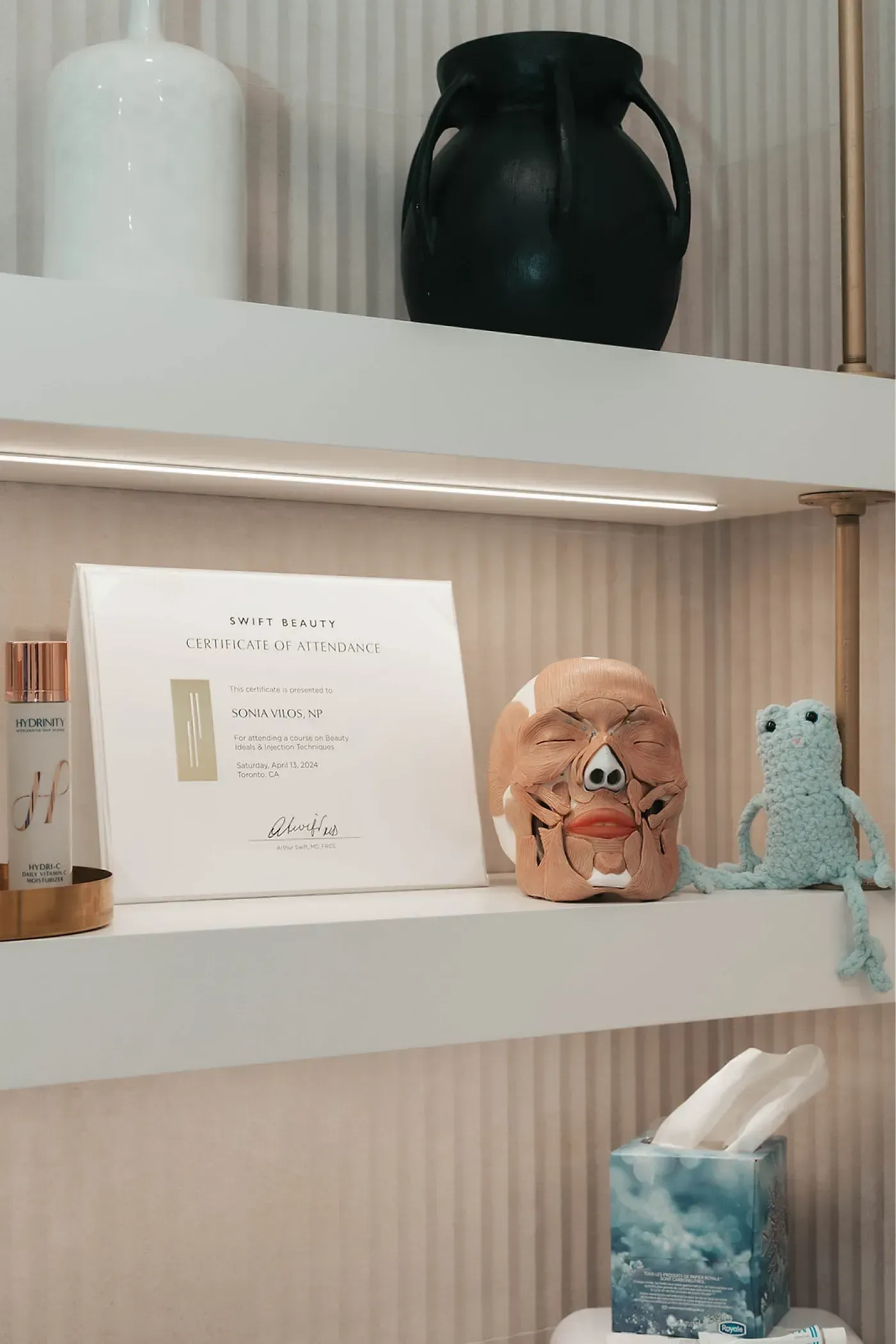
What changes first is the structure underneath it. Bone resorbs. The orbital rim recedes. The pyriform aperture – the pear-shaped opening around the nose – widens. The angle of the jaw softens. The scaffolding the entire face is built on shifts, and the soft tissue that once sat on a specific architecture now sits on a different one.
Simultaneously, the fat compartments of the face – and there are many, stacked in distinct layers with distinct blood supplies and distinct rates of change – begin to deflate and descend. Not uniformly. The medial cheek fat deflates earlier than the lateral. The deep compartments shift before the superficial ones follow. The face doesn’t fall as a single unit. It reorganizes, unevenly, over decades.
The retaining ligaments that hold soft tissue in position weaken. The tissue they were anchoring migrates inferiorly. What reads as a jowl is often displaced cheek volume. What reads as a hollow under the eye is often the result of a fat compartment that has thinned while the ligament above it held firm, creating a visible ledge.
The skin responds to all of this. It has less to lie over. It follows.
This matters clinically because the treatment follows from the diagnosis.
If you assess aging as primarily a skin problem, you treat the skin. If you assess it as a structural problem – bone, fat, ligament – you treat the structure, and the skin response follows.
Chasing the surface when the architecture has changed underneath it produces results that look worked on without looking restored. The tissue is fuller but the proportions are wrong, because the proportions were determined by structure that wasn’t addressed.
The structural model of facial aging changes what questions you ask in a consultation. Not just what bothers you – but where the volume was, what supported it, and what the face looked like before the reorganization began. The treatment plan is a hypothesis about what the face is trying to get back to.
This is not a new framework. The anatomical research has been building for over a decade – cadaveric dissection, imaging studies, compartment mapping. What’s new is how slowly it’s moved from the research into the room.
Patients are still being assessed at the surface. Results are still being planned from the complaint rather than from the anatomy. And then everyone wonders why filler migration happens, why results look unnatural, why the same volume of product produces a different outcome in a different patient.
The anatomy was different. The anatomy is always different.
That’s where the assessment has to start.
Consultations are available here.
*Sonia Vilos is a Nurse Practitioner and the founder of bespøke by SkinAlchemy, a medical aesthetics clinic in London, Ontario (https://share.google/5QJ7uVVoHfHNUIMbS). She trained in facial anatomy under Dr. Sebastian Cotofana, Dr. Arthur Swift, Dr. Thuy Doan, and Julie Horne across programs in four countries.*